

After spending much of the weekend working hands-on with AI tools, the need for an AI policy for Australian businesses became impossible to ignore. The biggest immediate risk for the average business may not be the technology itself. It may be that AI has already entered the workplace without anyone deciding what staff can share with it, what it may be used for or who remains accountable when it gets something wrong.
By the Compuloop Editorial Team | Updated 20 July 2026 | Australian legal sources checked
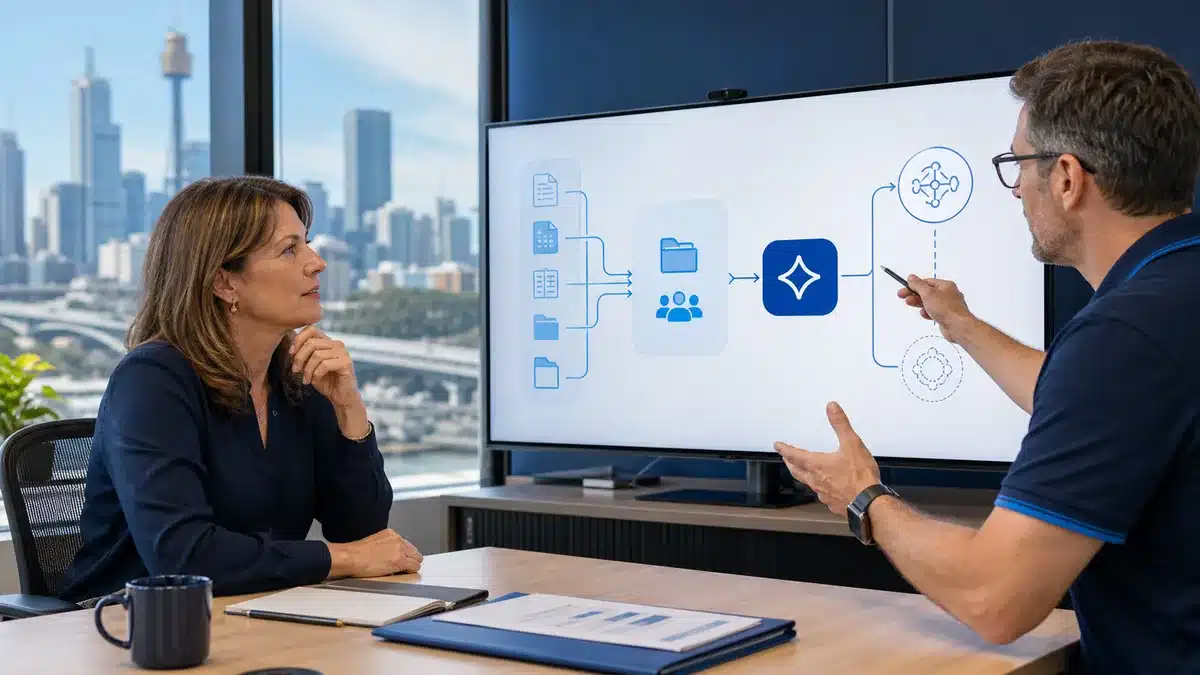
An employee asks a chatbot to summarise a contract. A manager uploads a spreadsheet to find trends. A salesperson pastes customer emails into a writing tool. A meeting assistant records a confidential discussion. A developer submits source code to an AI assistant.
Each action can feel harmless and productive. Together, they can expose customer information, commercial secrets, employee records, passwords, security settings and intellectual property to systems the business has never assessed.
This is why an AI policy for Australian businesses is no longer a document to leave on next year's planning list. It is a practical control that businesses need now.
The issue is not whether businesses should use AI. Used properly, AI can reduce repetitive work, improve access to information and help teams serve customers faster. The issue is whether the business—not individual employees acting alone—has decided how AI will be used safely.
The short answer for business owners
- Assume staff are already experimenting with AI, even if the business has not bought an AI product.
- Do not allow personal, sensitive, confidential or security-related information into an AI service until the service and the proposed use have been assessed.
- Do not assume that paying for an AI tool automatically makes every use private or compliant.
- Check the provider's current terms, privacy settings, retention rules, training settings, subcontractors and deletion options.
- Keep a qualified human accountable for every important output or decision.
- Create a short, usable policy, train staff and review it as tools and vendor terms change.
Australian law already applies to business AI
Australia does not need a single, stand-alone AI Act before legal obligations arise. Depending on the organisation and the use, existing privacy, consumer, employment, anti-discrimination, copyright, confidentiality, contract, work health and safety, and state or territory surveillance laws can already apply to AI systems and their outputs.
Privacy Act coverage must be assessed rather than assumed. Most businesses with annual turnover of $3 million or less are not covered, but important exceptions apply regardless of turnover, including health service providers, businesses trading in personal information, Commonwealth contracted service providers and several regulated categories. The private-sector employee-records exemption is also limited: it does not automatically cover unsuccessful applicants, contractors, volunteers or information handled by an external service provider.
Meeting transcription requires particular care. In New South Wales, recording a private conversation can be prohibited unless consent or another statutory exception applies. Employer surveillance can also trigger notice, policy and use restrictions under workplace-surveillance legislation. An AI meeting assistant should not be enabled by default without checking the people involved, the information likely to be discussed and the applicable state or territory law.
The Office of the Australian Information Commissioner recommends, as a matter of best practice, that organisations do not enter personal information—and particularly sensitive information—into publicly available generative AI tools because of the significant privacy risks. Its guidance also says organisations should conduct due diligence, establish AI policies and procedures, train staff and keep reviewing products throughout their lifecycle.
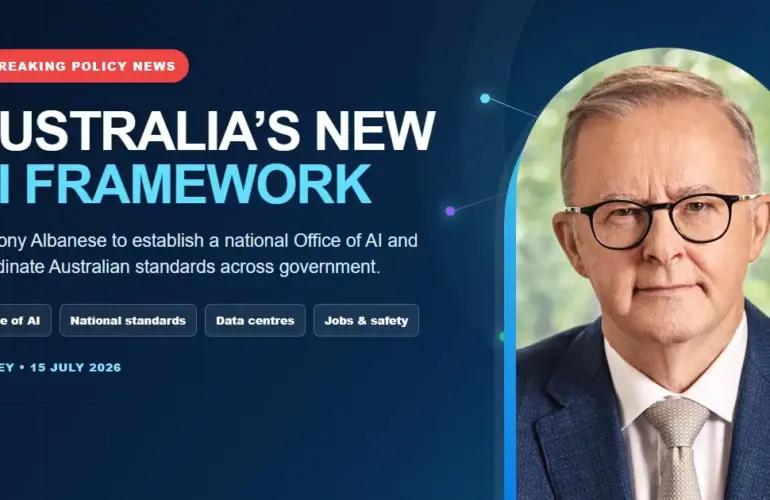
Australia's newly established Office of AI and planned national standards reinforce the direction of travel, but businesses do not need to wait for new legislation before improving their controls. Compuloop's Australian AI standards 2026 report separates the measures already confirmed from proposals that still require consultation or legislation.

AI adoption is moving faster than business governance
The latest National AI Centre SME tracking reported that 43% of Australian small and medium businesses used some form of AI across December 2025 to February 2026. Adoption is no longer confined to large technology companies.
The same official analysis identified a governance gap. Checking outputs before they affect customers was the most common safeguard among businesses already using AI, but transparency and formal processes for customers to raise concerns lagged behind.
That gap matters. A business can get a useful answer from an AI tool while still mishandling the information entered, relying on an inaccurate output, breaching a customer commitment or creating uncertainty about intellectual property.
15 questions every Australian business should ask this week
1. Which AI tools are staff actually using?
Do not limit the inventory to ChatGPT, Microsoft Copilot or Google Gemini. Include meeting transcription bots, writing assistants, browser extensions, design tools, coding assistants, CRM features, accounting add-ons, customer-service bots and AI functions embedded in software the business already pays for.
Ask staff without framing the exercise as a hunt for wrongdoing. The immediate objective is visibility. If employees believe disclosure will get them punished, unapproved AI use will simply remain hidden.
2. What information are employees pasting, uploading or connecting?
Check for customer records, contracts, proposals, email threads, financial reports, payroll data, HR files, medical information, meeting recordings, supplier pricing, internal procedures, board papers, source code and business plans.
Also look at connected data. An AI assistant with access to an entire mailbox, SharePoint site, CRM or cloud drive creates a different level of exposure from a standalone prompt containing public information.
3. Could prompts contain personal or sensitive information?
Where the Privacy Act applies, privacy obligations can apply to personal information entered into an AI system and to AI output that contains or infers personal information. Existing obligations do not disappear because AI was used as an intermediary.
Even where a business believes an exemption may apply, customer contracts, confidentiality duties, industry rules, employment obligations and basic trust can still make careless disclosure costly. Privacy questions should be checked against the organisation's actual circumstances, not answered with a generic assumption.
4. Are passwords, API keys or security details reaching AI tools?
Credentials, recovery codes, firewall rules, network diagrams, vulnerability reports and system configurations should be treated as high-risk information. Staff may share them accidentally while asking for technical help.
An AI policy should explicitly prohibit the submission of secrets and provide an approved way for employees to obtain technical assistance. If a secret is exposed, the incident process should require prompt rotation and investigation—not merely deletion of the chat.
5. Does the provider retain prompts or use them to improve its models?
The answer varies by provider, product tier, account type, feature and setting. A vendor may offer different protections for a free consumer account and an enterprise service. Some tools allow model-training use to be disabled while still retaining data for a period for security, support or legal purposes.
Review the terms that apply to the exact product being used. Record the review date, because settings and terms change.
6. Where does the information go, and who else can access it?
Map the data flow. Where is it processed and stored? Which service providers or subprocessors receive it? Is information transferred overseas? Can administrators see employee prompts? Are web-search, plug-in or connector features sending information to additional parties?
Overseas hosting is not automatically unlawful. Where the Privacy Act applies, APP 8 generally requires reasonable steps before personal information is disclosed to an overseas recipient and can leave the Australian entity accountable for the recipient's handling, subject to statutory exceptions. Data location is therefore one part of the assessment—not a compliance answer by itself.
If the business cannot explain where important information travels, it cannot make an informed risk decision.

7. Who owns the input, and what rights does the provider receive?
There is no universal answer to “who owns the data?” The business may retain ownership of its material while granting the provider a contractual licence to host, process or use it. Confidential information can also lose practical protection if it is disclosed without appropriate controls, even when formal ownership has not changed.
Check the provider's terms for rights over prompts, uploaded files, feedback, generated content and usage data. Ownership, access, retention and permission to train a model are separate questions.
8. Can the business safely own and use the output?
IP Australia warns that copyright protection can be uncertain where material is generated substantially by AI because copyright commonly depends on human authorship. AI output may also resemble third-party material without the user realising it.
Before using AI-generated logos, software, reports, images or campaign material commercially, check the tool's terms, preserve evidence of meaningful human contribution and review the output for third-party rights. IP Australia says employers generally own IP employees create in relation to the business, while contractors generally own the IP they create unless the contract says otherwise. Written agreements should address AI-assisted work before a dispute arises.
9. Who checks whether the answer is true?
AI can produce an articulate, confident and incorrect response. It can invent sources, misread a spreadsheet, omit an exception or provide outdated technical advice.
Define which outputs require verification and who is qualified to perform it. Legal, financial, medical, employment, safety and cybersecurity decisions need a much stronger review process than a first draft of a routine internal email.
10. Is AI affecting a customer, employee or applicant?
The risk rises when AI helps decide who receives a job interview, credit, pricing, support priority, disciplinary action or another outcome that significantly affects a person.
Businesses should know when AI is part of a decision, be able to explain its role, allow an appropriate human to intervene and provide a path for concerns to be reviewed. “The system decided” is not a responsible accountability model.
For organisations covered by the Privacy Act, existing transparency and accuracy obligations can already apply. From 10 December 2026, APP privacy policies must also contain specified information about certain decisions made, or substantially and directly assisted, by computer programs using personal information where the decision could significantly affect an individual's rights or interests.
Other laws remain relevant. Introducing AI can require employee consultation where it is a major technological workplace change likely to have significant effects under an applicable award or enterprise agreement. Discriminatory recruitment or employment outcomes can engage anti-discrimination and Fair Work laws, while misleading customer-facing outputs or claims can engage the Australian Consumer Law. Responsibility does not disappear because a vendor supplied the system.
11. Are staff using managed business accounts?
Consumer accounts created with personal email addresses leave the business with weak control over access, retention and offboarding. Approved business accounts should use appropriate licences, single sign-on where available, multifactor authentication, role-based access, logging and central administration.
Licensing is only one control. A business account does not make an unsuitable use safe, but it gives the organisation a better foundation for applying policy and security settings.
12. Does the company have a policy employees can actually follow?
A policy that says only “use AI responsibly” is too vague. Staff need clear examples of approved tools, prohibited information, allowed tasks, activities requiring approval and outputs requiring human review.
The policy should be short enough to use during a normal workday and supported by more detailed standards where needed. A total ban may drive experimentation underground; practical boundaries give employees a safe path to useful adoption.
13. Have staff been trained to recognise AI risk?
Training should cover prompt privacy, confidential information, hallucinations, copyright, bias, phishing, deepfakes, customer disclosure and incident reporting. It should use examples from the organisation's real work rather than generic technology slides.
Employees should know that deleting a conversation from their screen may not mean every retained copy has been erased from the provider's systems.
14. What happens when someone shares the wrong information?
Create a simple reporting route before an incident occurs. Staff should know whom to contact, what details to preserve and why early reporting matters.
The response may involve disabling a connector, removing access, rotating credentials, asking the provider to delete data, reviewing logs and assessing privacy or contractual obligations. Not every accidental AI disclosure is automatically notifiable under the Notifiable Data Breaches scheme. For a covered entity, notification generally depends on unauthorised access, disclosure or loss that is likely to cause serious harm and has not been successfully addressed through remedial action. Other contractual, sector-specific or state obligations may still require action.
15. Who is accountable for AI across the business?
Assign a senior owner with enough authority to approve tools, resolve exceptions and make sure reviews occur. IT, cybersecurity, privacy, legal, HR and business teams may all contribute, but accountability must not disappear between departments or suppliers.
Maintain an AI register recording the tool, owner, purpose, data involved, risk level, approved users, vendor review, human oversight and next review date. The Australian Government's current AI adoption guidance treats accountability as the first essential practice.
What an AI policy for Australian businesses should contain
An effective policy does not need to begin as a 50-page legal document. For many small and medium businesses, the first version should clearly cover:
- Purpose and scope: which employees, contractors, systems and business activities the policy covers.
- Approved and prohibited tools: including who can authorise a new service or feature.
- Data rules: what may be entered, what must be anonymised and what must never be shared.
- Approved uses: low-risk activities staff can perform without additional permission.
- High-risk uses: decisions or workflows requiring specialist assessment and written approval.
- Human review: which outputs must be checked, by whom and against what evidence.
- Security controls: business accounts, access management, MFA, logging, connectors and offboarding.
- Privacy and disclosure: how personal information is handled and when customers or employees must be informed.
- Intellectual property: rules for confidential inputs, third-party works, commercial output and recordkeeping.
- Incident reporting: how staff report accidental disclosure, harmful output or suspicious AI activity.
- Training: induction, role-specific instruction and refresher requirements.
- Governance: the accountable owner, AI register, exception process and review schedule.
A five-day AI governance reset for this working week

Businesses do not need to solve every AI question by Friday. They can establish meaningful control in one working week.
Monday — discover: ask teams which AI tools and embedded features they use. Start an AI register.
Tuesday — classify: identify the data reaching those tools and mark the highest-risk uses, connections and accounts.
Wednesday — decide: approve suitable low-risk uses, pause unacceptable uses and publish an interim AI policy.
Thursday — configure: move approved users to managed accounts, apply MFA and access controls, review retention and training settings, and disable unnecessary connectors.
Friday — train and test: brief staff using real examples, confirm the incident route and test whether employees can distinguish an allowed prompt from a prohibited one.
The policy should then mature with the business. Review it when a major tool, feature, contract, workflow or legal requirement changes—not only once a year.
The managed IT question most businesses are missing
An effective AI policy for Australian businesses is not separate from everyday IT management. It depends on the same foundations: knowing which systems are in use, controlling identities, securing endpoints, managing Microsoft 365 permissions, protecting data, reviewing suppliers, keeping logs and responding quickly to incidents.
An AI policy cannot compensate for an employee account without MFA, an overexposed SharePoint site or a former contractor who still has access. Conversely, a well-managed IT environment makes safe AI adoption far easier because the business already knows where its information lives and who can reach it.
Compuloop helps Australian businesses review AI use in the context of their real technology environment. That can include an AI tool and data-flow inventory, Microsoft 365 and Copilot readiness, identity and permissions review, cybersecurity controls, practical staff policy, training priorities and an implementation roadmap tied to useful business outcomes.
Put your business in control of AI
Before your team puts more company information into AI, make sure the business has made the decision—not the software.
Book an AI Data and Governance Review or explore AI automation services for small business and managed IT support for small business.
Sources and editorial note
- OAIC: Guidance on privacy and the use of commercially available AI products
- OAIC: Small business and Privacy Act coverage
- OAIC: Employee records exemption
- OAIC: APP 8 cross-border disclosure guidance
- OAIC: Notifiable Data Breaches scheme
- National AI Centre: Guidance for AI adoption—foundations
- National AI Centre: AI adoption insights, December 2025 to February 2026
- National AI Centre: AI and Australian law
- Australian Cyber Security Centre: AI data security
- IP Australia: Considerations when using AI to create IP
- IP Australia: Who owns intellectual property?
- Fair Work Ombudsman: Consultation and cooperation in the workplace
- NSW legislation: Surveillance Devices Act 2007
- NSW legislation: Workplace Surveillance Act 2005
This article is general information, not legal advice. Laws, provider terms and AI services change. Businesses should obtain advice for their circumstances and verify the current terms and settings of every service they use. AI-assisted tools helped organise source material and prepare the article; the claims, distinctions and links were reviewed before publication.