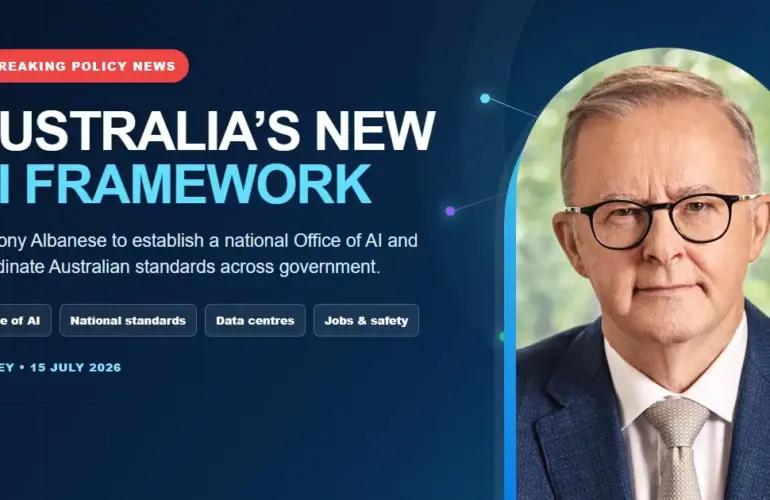


Australian AI standards are moving from broad policy expectations toward a national regulatory framework after Prime Minister Anthony Albanese formally established an Office of AI and announced mandatory standards for future large AI data centres.
The Office of AI is operating now. The standards are a government commitment, but they are not yet law: National Cabinet agreement, consultation and legislation are still required.
By the Compuloop Editorial Team | Published 15 July 2026 | Reporting cutoff: 4:30pm AEST

Australian AI standards: the decision in 60 seconds
Confirmed now
The Office of AI was established with immediate effect inside the Department of the Prime Minister and Cabinet.
Committed, not law
The government will pursue mandatory national standards, beginning with requirements for future large AI data centres.
Still unresolved
Final legal wording, enforcement powers, business-wide AI duties and the copyright mechanism have not been published.
Albanese said the new office would coordinate the design of the standards and work already under way across industry, energy, copyright, employment, education, defence and government services. The post-speech ABC report confirms that the government intends to seek state and territory agreement next month and bring legislation to Parliament in early 2027.
What the new Office of AI will do
Effective 15 July 2026, the Office of AI sits inside PM&C rather than operating as a standalone regulator. Its immediate job is coordination: designing the Australian AI standards and connecting work spread across multiple portfolios.
- Industry and investment: develop a clearer national approach to AI capability and major infrastructure.
- Energy and climate: coordinate requirements for the electricity and water demands of data centres.
- Copyright: connect the Attorney-General’s work on creators, licensing and AI training data.
- Jobs and education: coordinate work on employment, skills, schools and workforce transition.
- Security and defence: bring national-security and sovereign-capability questions into the same framework.
- Government adoption: connect public-sector AI use, assurance, procurement and service-delivery work.
The speech did not give the office independent enforcement powers, a statutory commissioner or a detailed budget. Calling it a new AI regulator would therefore go beyond the official announcement.
What does the announcement mean for your business AI plans?
Compuloop can review Microsoft 365 and Copilot permissions, AI tools, sensitive data, staff workflows and security controls—then build a practical readiness roadmap.
Book a business AI readiness reviewSee AI automation supportCall 1300 007 613
The proposed mandatory rules for AI data centres
The most detailed policy commitments concern future large AI data centres. The government intends to turn its March 2026 developer expectations into one clear, consistent and mandatory national framework.
The standards are also expected to address where facilities are built, supporting infrastructure, sovereign capability and genuine community engagement. The objective is to prevent households and local communities from carrying infrastructure costs created by private developments.

This 2022 construction photograph documents the delivery of NEXTDC S3 in Artarmon. It is included as a real Australian example of the scale and complexity of data-centre development—not to suggest the proposed 2026 standards existed when S3 was approved or that they will apply retrospectively.

NEXTDC describes S3 as an operational 80 MW, 20,000-square-metre facility. The real data-hall image shows the physical layer behind cloud and AI services: servers, networking, cooling, power and access controls all have to operate together.
What Albanese said about AI and copyright
The Prime Minister gave a clear policy assurance that Australian writers, musicians, artists and journalists should retain ownership and control over their work. He said AI companies should not train on Australian creative material without the creator controlling permission, price and value.
That is politically significant, but it is not yet a complete copyright regime. The speech did not publish draft amendments, a licensing system, payment formula, enforcement body or commencement date. Businesses should not assume that every copyright question involving model training or generated output has now been resolved.
The practical baseline remains that existing Australian law applies to AI. Copyright, privacy, confidentiality, consumer, employment and contractual duties can apply before any AI-specific legislation is passed.
What was not announced
- No complete AI Act: the government did not introduce comprehensive AI legislation today.
- No final standards: draft legal text, thresholds, exemptions and enforcement details remain unpublished.
- No new SME deadline: ordinary businesses were not given an immediate registration or compliance date.
- No detailed workplace rules: consultation continues on jobs, consultation, training and worker protections.
- No funding or tax package: the speech did not announce a new AI subsidy, tax incentive or grant program.
- No settled copyright mechanism: creator control was promised, but licensing and enforcement details remain open.
This matters because a political commitment, an administrative decision and a law are different things. Reporting them separately helps businesses avoid both panic and false confidence.

What Australian businesses should do now
The Australian AI standards do not create an immediate new compliance deadline for most SMEs. They do reinforce the direction of travel: businesses will increasingly be expected to know which AI systems they use, what information those systems receive and who remains accountable for the outcome.
- List every AI tool: include public chatbots, browser extensions and AI features embedded in Microsoft 365, CRM, HR and security platforms.
- Review permissions: Copilot and similar tools can surface information that staff technically have access to but should not broadly see.
- Protect sensitive data: define what staff must never enter into public or unsuitable AI services.
- Check vendor terms: examine data retention, model training, hosting, deletion, incident notification and subcontractors.
- Keep human approval: require review for employment, legal, financial, safety, customer and security decisions.
- Document ownership: assign a responsible leader and record approved use cases, controls, incidents and review dates.
The OAIC’s privacy guidance for commercially available AI products is already relevant. A business does not need to wait for the new standards before improving data handling and AI governance.
What happens next
Those dates describe the government’s announced pathway. They do not guarantee passage, final scope or commencement. The legislation may change during consultation and parliamentary scrutiny.
Frequently asked questions
Has Australia established an Office of AI?
Yes. Albanese said the Office of AI was established effective 15 July 2026 inside the Department of the Prime Minister and Cabinet.
Are the Australian AI standards already law?
No. The government has committed to the standards, but it still plans to seek National Cabinet agreement, consult stakeholders and bring legislation to Parliament in early 2027.
Will the rules apply to every Australian business?
The first detailed mandatory requirements target future large AI data centres. The government has not yet published general mandatory AI duties for every business.
Did Australia change copyright law today?
No legislation was introduced today. Albanese committed to creator ownership, control and pricing, but the legal mechanism and final wording remain to be developed.
Do businesses need to stop using AI?
No. Businesses should use AI deliberately: approve suitable tools, protect confidential information, review vendor terms, secure access and retain human accountability for important decisions.
Build a business AI plan before the rules catch up
Compuloop helps Australian organisations turn AI interest into a controlled implementation: Microsoft Copilot readiness, permissions, cybersecurity, staff guidance, workflow automation and ongoing managed support.
Plan my AI readiness roadmapReview AI security supportEmail Compuloop
Sources, methodology and corrections
This article distinguishes the delivered announcement from proposals that still require agreement, consultation or legislation. Primary government material was used wherever available, supported by post-speech reporting.
- Prime Minister of Australia: AI in Australia’s interests—delivered speech, 15 July 2026
- ABC News: post-announcement report on the Office of AI, data-centre rules and copyright
- Australian Government: expectations for data centres and AI-infrastructure developers
- Australian Government: National AI Plan
- National AI Centre: AI and Australian law
- OAIC: privacy guidance for commercially available AI products
- Infrastructure and image sources: NEXTDC S3 Sydney facility and the S3 construction milestone.
Editorial note: reporting cutoff 4:30pm AEST, 15 July 2026. This report is general information, not legal advice. AI-assisted tools helped organise source material and page production; claims, distinctions and links were reviewed before publication. Corrections will be added transparently if the implementation pathway changes.