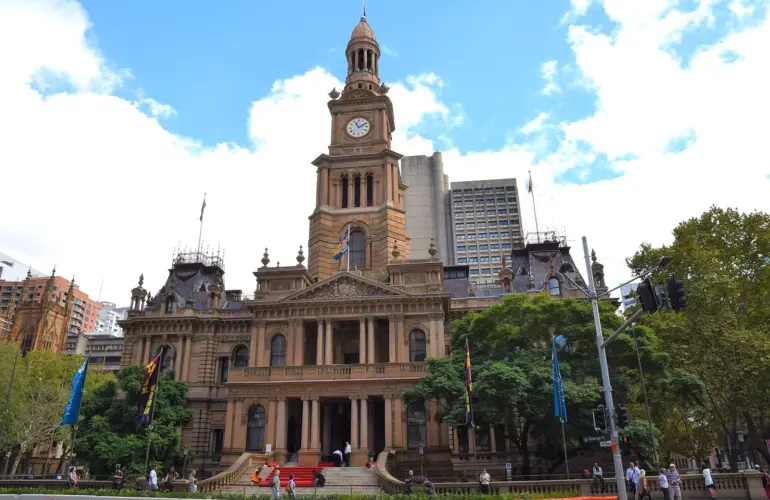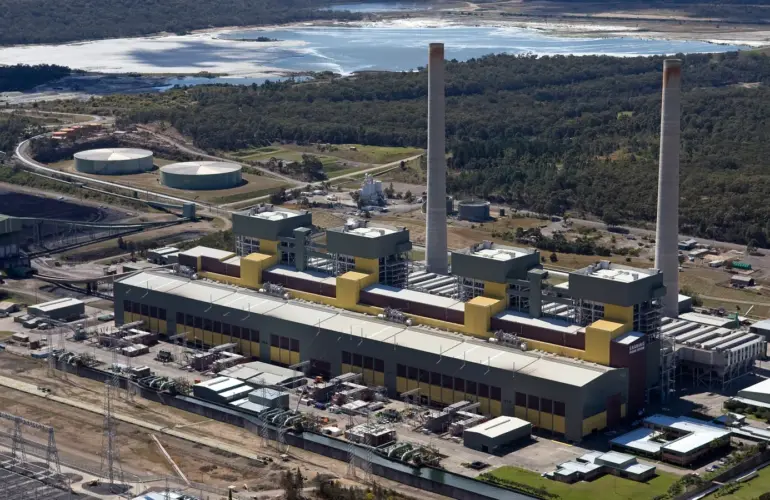


Australia’s AI framework is set for a major change, with Prime Minister Anthony Albanese expected to establish a national Office of AI and move away from a fragmented, issue-by-issue response to artificial intelligence.
The new office is expected to sit inside the Department of the Prime Minister and Cabinet, coordinate “Australian standards” and bring together work on data centres, investment, jobs, copyright, privacy, education, defence and AI safety.
By the Compuloop Editorial Team | Published 15 July 2026 | Reporting cutoff: 9:30am AEST
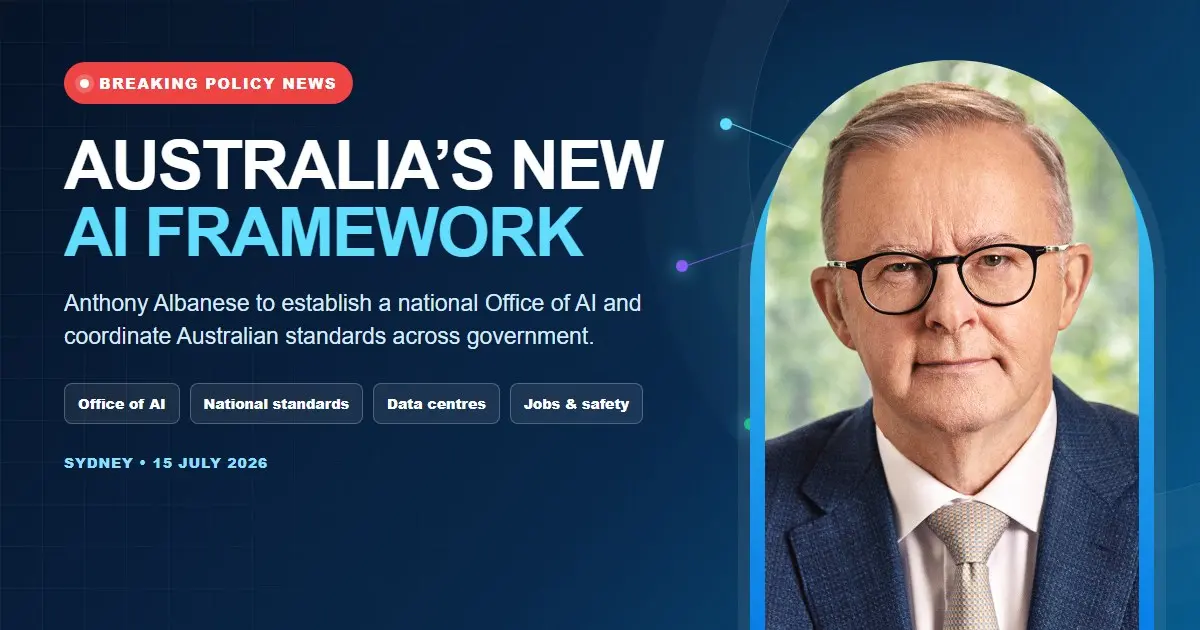
Australia AI framework 2026: the short answer
According to the speech preview reported by ABC News and Reuters reporting, Albanese will announce an Office of AI at the centre of government. Its role will be to coordinate national policy and the design of new Australian standards rather than leave each department, regulator and state to work in isolation.
What is confirmed so far: an Office of AI is expected inside PM&C; a single national framework is intended to coordinate government work; and the approach will cover economic, social, national-security and environmental questions. What is not confirmed: the final legal powers, implementation dates, detailed standards, enforcement model and any change to copyright law.
The announcement is strategically important, but it should not be described as a complete new AI law. Australia currently applies existing privacy, consumer, employment, intellectual-property and sector laws to AI while developing policy, standards and assurance mechanisms.
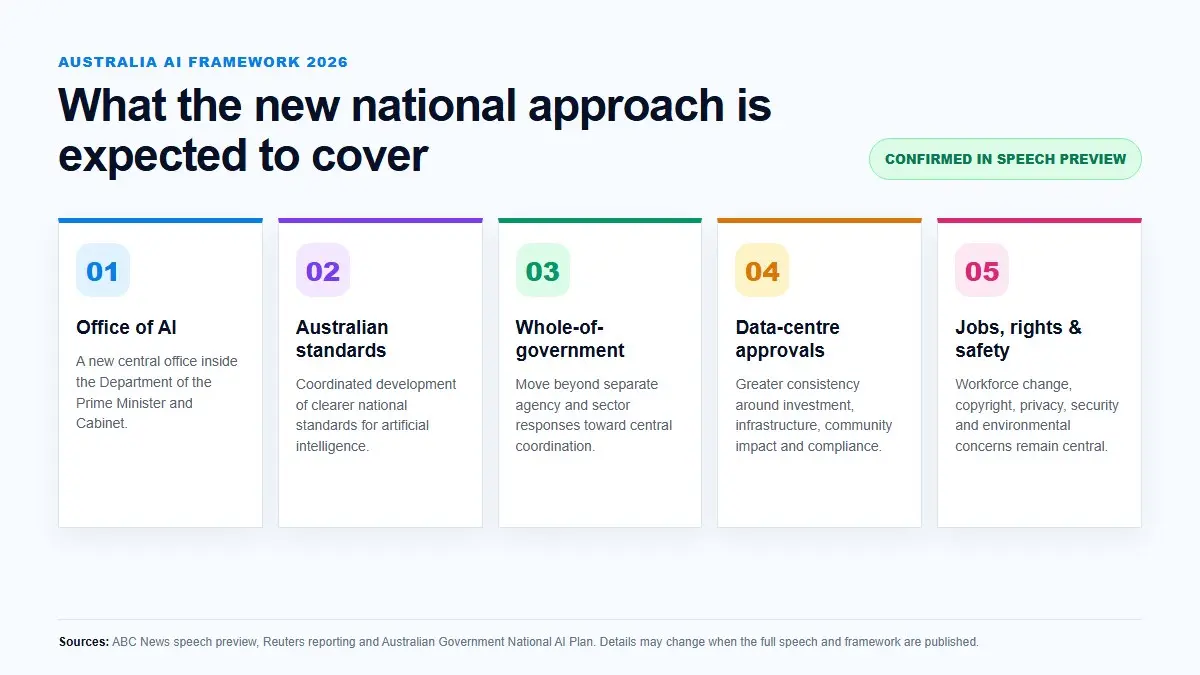
What Albanese is expected to announce
Office of AI
A central office inside the Department of the Prime Minister and Cabinet is expected to coordinate policy across government.
Australian standards
The office is expected to coordinate clearer national standards, approvals and compliance processes.
Data centres
Government wants a more consistent approach to investment, planning, infrastructure and community impacts.
Jobs, rights and safety
Workplace change, copyright, privacy, security, education and defence remain central policy questions.
The central policy argument is coordination. The preview says AI touches every minister and department, making an issue-by-issue and sector-by-sector response increasingly difficult. The Office of AI is intended to bring that work together and provide clearer direction for government, business and investors.
The proposal also points to faster and clearer approvals for AI infrastructure. Data centres require land, power, water, communications links and planning decisions, and Australian states have taken different approaches. The ABC preview says the federal government wants greater consistency without yet publishing the detailed approval model.
The real news is not that Australia has suddenly discovered AI policy. It is that the Prime Minister wants one central framework to coordinate policy areas that have so far developed separately.
Planning to use AI in your business?
Start with the systems and information you already own. Compuloop helps Australian businesses assess Microsoft 365 and Copilot readiness, permissions, security, staff workflows and practical automation opportunities.
Book an AI readiness reviewSee AI automation supportCall 1300 007 613

Fact check: is Australia the third country with an AI policy?
For comparison, the European Union’s AI Act entered into force in August 2024. The United States released America’s AI Action Plan in July 2025. The United Kingdom published its AI Opportunities Action Plan in January 2025, while Canada has operated a national AI strategy in successive phases.
The “third” statistic may come from Australia’s National AI Plan, which says Australia ranked third globally for use of Anthropic’s Claude model. That is a measure of product adoption—not a ranking of national AI policies.

How the new Office of AI fits Australia's existing policy
Australia already had a substantial AI policy base before today’s announcement. In June 2024, federal, state and territory ministers agreed to a national framework for the assurance of AI in government. That work focused on responsible, safe and accountable government use.
In December 2025, the government released a broader National AI Plan built around three goals: capturing opportunities, spreading the benefits and keeping Australians safe. The plan also backed an Australian AI Safety Institute, which is now undertaking technical safety work and international cooperation.
The proposed Office of AI appears to sit above and across these initiatives. Its value will depend on whether it can turn overlapping plans, standards and agency responsibilities into clear decisions, measurable timelines and practical guidance.
The real infrastructure behind Australia's AI expansion
AI policy needs physical infrastructure: land, substations, grid connections, cooling, fibre and secure hosting. The projects below are real Australian facilities, not generic stock images. They are not government-owned data centres; they are privately operated sovereign or government-certified campuses designed to support government, critical-infrastructure, enterprise, cloud and AI workloads.
The Australian Government’s National AI Plan opportunity chapter points to major private investment from CDC, Firmus, Amazon and Microsoft. In March 2026, the government also published expectations for data-centre and AI-infrastructure developers covering national interest, sovereignty, sustainability and community benefit.

IC3 Super West — Macquarie Park, Sydney
Macquarie Data Centres says IC3 Super West is under construction at its Macquarie Park campus and is scheduled to be ready for service in September 2026. The facility is purpose-built for high-density AI and cloud infrastructure, including government and critical-infrastructure workloads.
The construction photograph records the December 2025 topping-out milestone. It is an official project image from Macquarie Data Centres, not an architectural render.

CDC Eastern Creek and Marsden Park — western Sydney
CDC says its Eastern Creek campus includes operating facilities EC1 to EC4, with EC5 and EC6 under construction. Its Marsden Park development is in early construction and is planned as a 504 MW campus across six buildings. The operator positions both campuses for sovereign, government, critical-infrastructure and high-density computing requirements.
The aerial photograph shows CDC’s operating Eastern Creek campus; it does not claim to show the unfinished Marsden Park buildings. CDC’s official Marsden Park announcement contains the development details.

Your business does not need its own data centre to use AI safely
The practical work happens closer to home: clean permissions, secured identities, governed data and a business case tied to real workflows.
Why this matters for Australian businesses
For most Australian businesses, the announcement does not create an immediate new compliance deadline. It does, however, signal that AI governance is moving from optional experimentation toward normal business accountability.
- Clearer rules: national standards could reduce conflicting expectations across agencies and sectors.
- More scrutiny: businesses may need to explain where AI is used, what data it touches and who remains accountable.
- Supplier risk: AI features embedded in Microsoft 365, CRM, HR, security and customer-service platforms still require review.
- Workforce change: employers need training, consultation and human oversight—not just software licences.
- Copyright questions: businesses must consider what material is entered into AI tools and how generated material is used.
- Cybersecurity: AI expands phishing, data leakage, identity and vendor risks while also improving detection and automation.
Small and medium businesses should avoid waiting for a perfect final rulebook. The safe starting point is to know which AI tools are in use, what information employees enter, which vendors retain or train on data, what outputs affect customers or staff, and where a human must review the result.
A practical AI-readiness checklist for SMEs
- Inventory tools: list approved and unapproved AI services, browser extensions and embedded copilots.
- Classify data: prohibit sensitive customer, employee, legal, health and security data from unsuitable tools.
- Review contracts: check retention, training use, hosting location, incident notification and deletion terms.
- Assign ownership: make a named leader accountable for AI policy, exceptions and incident response.
- Keep humans involved: require review for employment, financial, legal, safety, customer and security decisions.
- Secure access: use managed identities, MFA, least privilege, logging and offboarding for business AI tools.
- Train staff: teach prompt privacy, verification, copyright awareness, hallucination risk and escalation.
- Record decisions: document high-impact use cases, tests, approvals, known limitations and review dates.
This checklist is practical risk management, not a substitute for legal advice. Existing Australian privacy, consumer, workplace, copyright and sector obligations can apply whether or not a future AI-specific law is introduced.
The questions the full framework still needs to answer
Power and accountability
Will the Office of AI merely coordinate, or will it set binding standards, review agencies and publish performance measures?
Mandatory or voluntary?
Which standards will be compulsory, who will enforce them and how will they interact with existing regulators?
Copyright and data
How will training data, creator rights, licensing, privacy and confidential business information be treated?
SME support
Will smaller businesses receive templates, safe-harbour guidance, training and proportionate compliance pathways?
Data-centre policy also needs detail. Faster approvals may attract investment, but communities will expect transparent information about grid capacity, water use, land, local infrastructure, security, employment and long-term public benefit.
Frequently asked questions
What is Australia's new AI framework?
It is a proposed whole-of-government framework intended to coordinate Australia’s response to AI across economic, social, national-security and environmental issues. The full framework had not been published at our reporting cutoff.
What will the Office of AI do?
The office is expected to sit within the Department of the Prime Minister and Cabinet, coordinate Australian standards and bring together AI work already under way across departments and ministers.
Is the framework a new AI law?
Not on the information released so far. A framework can coordinate policy and standards without itself creating a new Act of Parliament. Existing laws continue to apply, and the government has not yet published the final powers or enforcement model.
Is Australia the third country to introduce an AI policy?
No. Many countries and regions already have AI strategies, plans, laws or institutions. The narrower claim in the speech preview is that Australia’s proposed single coordinated framework is a world-first.
What should Australian businesses do now?
Map current AI use, protect sensitive data, assess vendors, require human review for high-impact decisions, secure identities and document an internal AI policy. These controls are useful now and should make future compliance easier.
Make AI useful without losing control of your business data
Compuloop can help Australian businesses assess AI tools, Microsoft 365, identity, cybersecurity, data handling and staff controls—then turn the findings into a practical adoption plan.
Explore AI automation servicesReview cybersecurity supportBook an AI-readiness review
Sources, methodology and corrections
This breaking-news explainer prioritises Australian Government documents and clearly attributed reporting. We have separated the speech preview from established policy and have not repeated unsupported claims that Australia is the third country with an AI framework.
- ABC News: Anthony Albanese maps out AI future with new national framework
- Reuters: Australia to establish government AI office
- Australian Government: National AI Plan and full plan PDF
- Australian Government: AI Safety Forum and AI Safety Institute
- National framework for the assurance of AI in government
- Australian Government: National AI Plan—capture opportunities
- Australian Government: expectations for data centres and AI-infrastructure developers
- Macquarie Data Centres: IC3 Super West project details and construction milestone and photograph
- CDC Data Centres: Sydney campuses and Marsden Park development
- International comparisons: EU AI Act, US AI Action Plan, UK AI Opportunities Action Plan and Canada’s national AI strategy.
Editorial note: reporting cutoff 9:30am AEST, 15 July 2026. This article will be corrected or updated if the delivered speech or official framework differs materially from the preview. AI-assisted tools were used to organise research and create original graphics; claims and source links were reviewed before publication. This is general information, not legal advice.