








Retail & multi-site · Client identity withheld

Network security case study: a 22-store retail rollout

This network security case study shows how Compuloop separated payment systems, staff devices, guest Wi-Fi and CCTV across 22 Australian retail stores. The staged rollout ran after hours to protect trading.

Clothing racks and display areas inside a fashion retail store
$96KInvestment
22Stores segmented
$100K/moFee exposure removed
0Trading hours lost

Project technologies and related platforms we support

Fortinet logo
UniFi logo
SentinelOne
Cisco
Veeam
Synology
The starting point

The business challenge

The retailer had opened its 22nd store the month before we were engaged. Every store had been stood up the same way: an ISP router, a switch, whatever access points were on special, and a POS terminal configured by the vendor. Nobody had ever drawn the network.

The trigger was a landlord-required security review at a flagship shopping centre. The centre's IT team ran an external scan and flagged that guest Wi-Fi appeared to be on the same subnet as POS. The operations manager asked a reasonable question — “is that bad?” — and that question became the project.

What the assessment found

Guest Wi-Fi routable to POS terminals in all 22 stores. CCTV NVRs on default vendor credentials in 19 stores. Three stores with UPnP-enabled RDP exposed directly to the internet. Two stores sharing the guest Wi-Fi password with staff Wi-Fi. No VLANs anywhere, and no central visibility of store networks from head office.

Why it mattered

The realistic attack path was not sophisticated. A customer on guest Wi-Fi, or anyone in Wi-Fi range, could reach the POS subnet. With default NVR credentials, an attacker could pivot into the store network and attempt to reach head office over the site-to-site link. Card data was tokenised at the terminal, which limited direct card exposure — but POS held pricing, stock and integration credentials into head office systems, and three stores had RDP exposed. The commercial risk was a payment environment incident during peak trading, plus breached landlord and PCI obligations that were already overdue.

Technology in context

From the shop floor to the network

Card payment terminal

Payment systems in the real world

A card terminal illustrates why network reliability and controlled access matter at the point of sale. The project below explains the changes made around the retail environment.

UniFi U7 Pro Max WiFi 7 access point for high density business wireless networks

Managed wireless infrastructure

Retail networks need clear separation between business systems and guest traffic. Access-point hardware works together with the network design and support process.

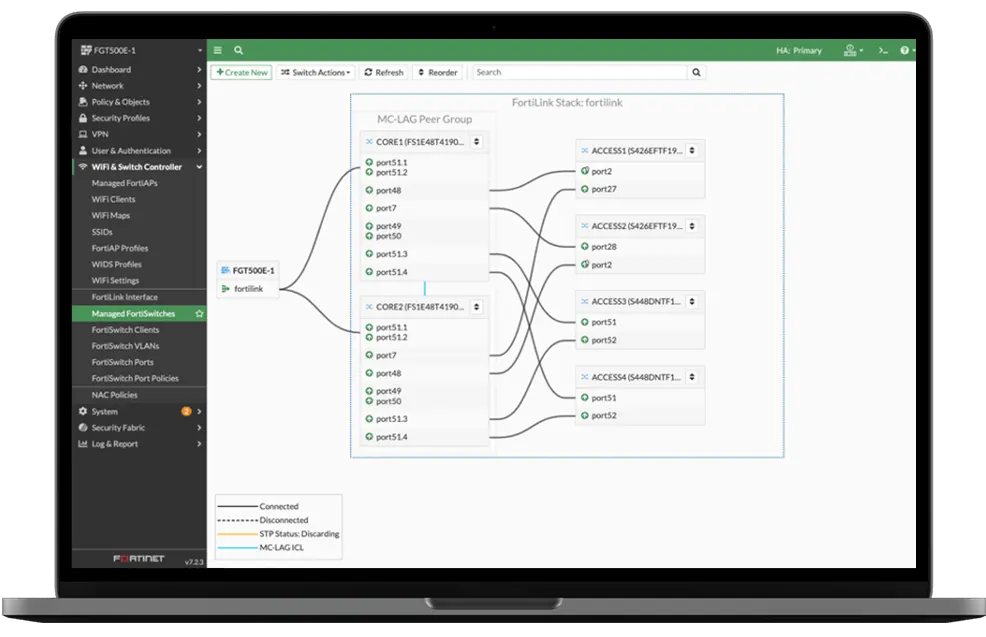
Fortinet FortiSwitch management product screenshot

Managing the wired network

Fortinet’s product interface illustrates switch administration.

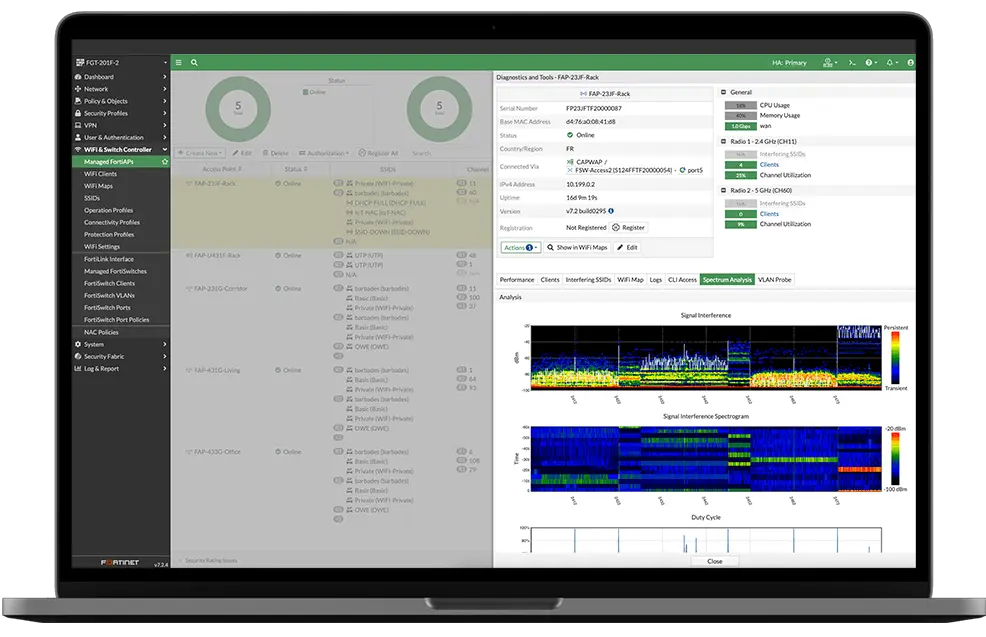
Fortinet FortiAP management product screenshot

Wireless visibility

A Fortinet product example shows wireless administration.

The implementation

How this network security case study was delivered

01

Weeks 1–2 · Design before deployment

Documented every store's topology and built a standard four-VLAN design: POS (payment), Corporate, Guest, and IoT (CCTV, access control, signage). Defined the inter-VLAN policy matrix before touching a store, so each rollout was a repeatable build rather than a bespoke job.

02

Weeks 2–4 · Pilot in two stores

FortiGate 60F firewalls and UniFi access points in two stores, managed centrally through FortiManager. Ran a full trading week before scaling — which is where we found the POS discovery problem.

03

Weeks 4–8 · Roll out 20 stores

Two stores per night after close, with a documented two-hour change window and a rollback plan. Each store: firewall swap, AP replacement, VLAN setup, policy load, NVR credential rotation, endpoint agent, and a signed-off test script covering POS, EFTPOS, printing, stock lookup and CCTV playback.

04

Weeks 8–9 · Centralise and evidence

FortiManager dashboards giving head office visibility of all 22 store networks, centralised logging, incident escalation path, and the records pack for PCI DSS v4.0 self-assessment.

Practical obstacles, handled in stages

  • POS relied on broadcast discovery. Isolating POS broke the terminal's ability to find its back-office server. We enabled a multicast DNS reflector with tightly scoped rules allowing only the POS discovery protocol between two defined hosts.
  • EFTPOS terminals on bank-supplied fixed IPs. Segmentation required readdressing, and the bank's change process took two weeks per store. We batched address changes three weeks ahead of each rollout.
  • Store managers as the only on-site hands. We wrote a laminated one-page checklist per store and ran a 15-minute video call per site so staff knew what “working” looked like at 7am.

Controls that stay in place

The project also established repeatable processes. These controls support ongoing operation after the initial rollout.

  • FortiManager centralised setup push across 22 stores
  • UniFi auto-provisioning — new store network in 2 hours, not 2 days
  • VLAN template deployment — identical build every site, no drift
  • Automated alerting on policy change and link failure
  • Centralised logging aggregating all store events
  • NVR credential rotation applied by policy across all sites

Get clarity across your store networks

Talk through your priorities, current systems and next practical step with Compuloop.

Discuss your project
Measured change

network security case study results

The following before-and-after figures relate to this engagement. The scope and starting position matter when comparing them with another business.

MeasureBeforeAfter
Stores with POS isolated from guest Wi-Fi0 of 2222 of 22
Internet-exposed RDP instances30
CCTV devices on default credentials190
Head office network visibilityNone22 stores, centralised
PCI DSS self-assessmentOverdue, incompleteSubmitted and cleared
Trading disruption during rollout—Zero

Time returned to the team

2 days → 2 hrs

New store network build

4h → 20m

Monthly fault diagnosis per store

Continuous

Config drift detection (was quarterly manual)

1 view

All 22 stores (was 22 phone calls)

The financial picture

Project-specific financial model. Avoided losses and productivity benefits are estimates, not guaranteed cash savings or returns.

Line itemValue
Project investment (9 weeks, 22 stores)$96,000
Cost per store$4,364
Avoided: PCI non-compliance fee exposure (per month)Up to $100,000
Avoided: breach investigation and re-certification$60,000–$120,000
Avoided: 5-day peak outage at 22 stores~$310,000
Annual recurring: fault diagnosis time saved~$30,000 / yr
Annual recurring: store build time saved (4 stores/yr)~$6,000 / yr
PaybackImmediate against fee exposure

Lessons for your business

  • A flat network is the default outcome of growth, not a decision anyone made. Draw it before you're asked to.
  • Segment payment traffic first — it's the highest-value, most defensible change and it satisfies PCI and landlord reviews.
  • Pilot two stores for a full trading week. POS quirks only appear under real transaction load.

Explore the relevant services

Background guidance: read the relevant official framework or product documentation. This explains the technology; it is not independent verification of this client project.

Discuss a similar project

If this network security case study reflects a problem in your business, start with a scoped conversation. Tell us about your sites, people, systems and current priorities. We can then identify the right assessment, the practical constraints and the evidence you need.

Compuloop case studies

Download case study

Network security case study: a 22-store retail rollout

Enter your details and agree to email updates. We will email a secure link that confirms your address and opens this PDF. You can unsubscribe from marketing at any time.

    Compuloop Pty Ltd collects these details to manage your PDF request and email subscription. Your contact details and consent record are stored using our WordPress/Mailchimp integration; Mailchimp may process data overseas. We do not enrol you in SMS marketing. Read our privacy policy or contact sales@compuloop.com.au.