


IT support for small business should make costs, ownership and response expectations easier to understand—not hide them behind a vague “all-inclusive” promise. The right plan depends on your number of people and devices, work locations, service hours, cloud platforms, security risk and how much internal IT capability you already have.
This guide shows the common support models, a real Australian public-pricing example, the exclusions that change the final bill and a provider checklist you can use before signing.
Hero photograph: Joyce Toh / Pexels, used under the Pexels licence. The people shown are not Compuloop staff or clients. View image source.
What should IT support for small business include?
A practical service connects everyday support with the systems that keep work moving. The exact boundary must be written into the agreement, but a well-defined plan commonly addresses these areas.
A clear way to lodge requests, remote troubleshooting, user communication, priority rules, escalation and confirmation that the issue is actually resolved.
An inventory of supported computers and mobile devices, operating-system health, patching, endpoint protection and a documented process for new or departing staff.
User administration, email, Teams or other collaboration tools, permissions, licence changes and escalation when a vendor platform is involved.
Routers, firewalls, switches, Wi-Fi and internet-provider coordination—when those items are explicitly included in scope.
MFA, privileged access, alerts, backups, restore testing, incident contacts and agreed actions when suspicious activity is detected.
Asset and risk visibility, recurring reviews, lifecycle planning, recommendations and a decision trail your business can understand.

Four common pricing models in Australia
You pay for time used. It can suit occasional faults, but spend and response availability are less predictable. Ask about minimum charges, travel, after-hours rates and whether remote diagnosis is billable.
A block of time is purchased in advance. Confirm expiry dates, rounding increments, which specialists can use the block and whether monitoring or security tools are included.
A recurring fee covers a defined service set. This improves budgeting, but “managed” is not a universal specification. Compare every inclusion and exclusion.
An external provider supports an internal IT person, a specific platform or a defined project. Responsibilities and escalation boundaries need special care.
How much does managed IT support cost per month?
There is no single Australian market price because providers package different tools, hours, devices and risks. A defensible comparison starts with a published rate card and then checks what that price actually includes.
Telstra’s Business Managed Services Rate Card, current 17 February 2026, lists maximum monthly charges for its Managed IT Services bundles at $100 Basic, $150 Standard and $200 Premium per user, including GST. Its document also says licences, hardware and devices, professional or solutioned services, and onsite support are not included and attract additional charges.
Open the official Telstra rate card (PDF)| Users | Basic example | Standard example | Premium example |
|---|---|---|---|
| 5 | $500/month | $750/month | $1,000/month |
| 10 | $1,000/month | $1,500/month | $2,000/month |
| 20 | $2,000/month | $3,000/month | $4,000/month |
| 50 | $5,000/month | $7,500/month | $10,000/month |
Worked arithmetic only: user count multiplied by Telstra’s published maximum monthly bundle charges, including GST. It does not compare bundle features and is not a recommendation, market range or Compuloop price. Confirm current terms directly with the provider.
Where Compuloop’s published packages sit
Compuloop publishes three per-user options. The prices below are the website prices checked on 17 August 2026, shown both before and after GST so buyers can compare them on the same tax basis. Pricing is a guide; the final scope still depends on users, devices, locations and risk.
Remote helpdesk, Microsoft 365 account, licensing and mailbox help, standard user-device troubleshooting, MFA and email-security guidance, backup-status review, basic network troubleshooting and a support summary.
Priority response, deeper Teams, SharePoint and permissions support, patch and endpoint visibility, EDR and phishing checks, restore and recovery advice, firewall, Wi-Fi and VPN support, plus monthly support and risk notes.
Priority escalation, advanced identity and endpoint-hardening reviews, security reporting, recovery planning, network-health and change review, plus quarterly business reviews for higher-risk environments.
For many small businesses, Managed is the practical middle choice. It is $40 ex GST per user/month above Essentials, while adding priority response and more ownership across Microsoft 365, endpoints, phishing and EDR checks, recovery, firewalls, Wi-Fi and VPNs. That broader operating scope is the value case—not a claim that every tool, project or onsite visit is unlimited.
Projects, onsite work and migrations are scoped separately across all three published packages. Compare the written scope with your actual devices, locations and risks before choosing.
Compare Compuloop’s current support packagesWhy two “$150 per user” plans can be completely different
The price becomes meaningful only when the units and boundaries are visible. One provider may include endpoint protection, Microsoft 365 administration and backup monitoring. Another may charge the same amount for helpdesk access while billing those items separately.
Are you paying per person, computer, mobile device, server, site, firewall, mailbox or cloud tenant? A 10-person business may have 18 supported devices and several shared systems.
Check business hours, public holidays, after-hours access, emergency contact methods and whether response targets change outside normal hours.
Acknowledging a ticket is not the same as restoring service. Ask how priorities are set, how updates are delivered and what happens when a third party causes the delay.
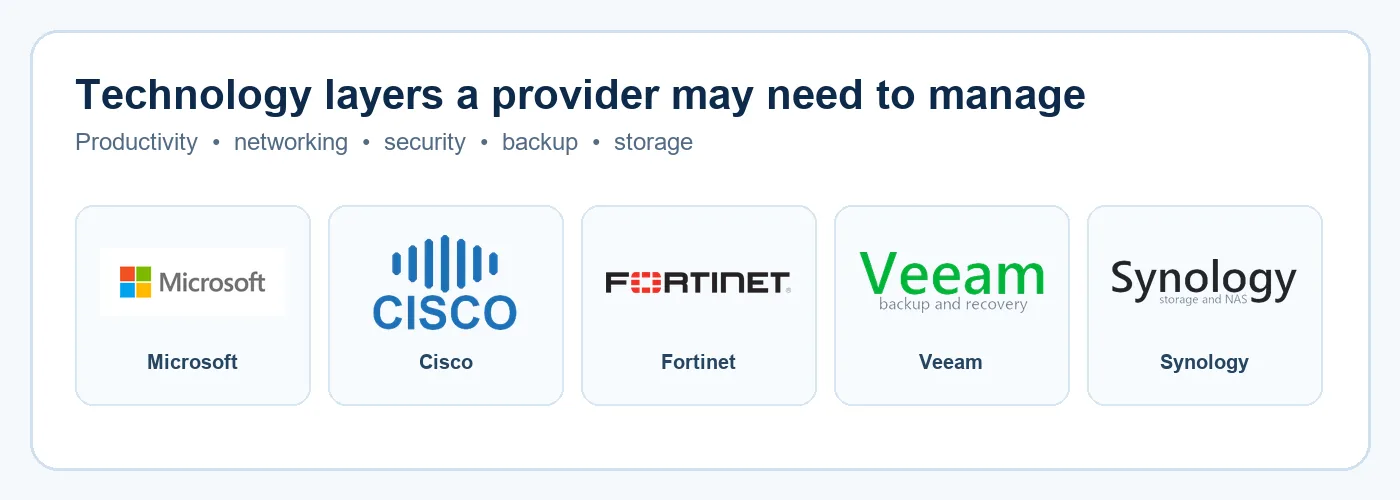
Monitoring, endpoint security, password management, email filtering, backup, documentation and remote-control tools may be bundled, optional or excluded.
Costs that are often outside the monthly fee
- Microsoft 365 and other licences: subscription charges can change independently of support fees.
- New computers and hardware: supply, setup, freight, warranties and disposal may be separate.
- Projects: migrations, office moves, tenant restructures, major upgrades and new-site work commonly require a quote.
- Onsite attendance: travel, parking, minimum call-outs and regional coverage may apply.
- After-hours work: emergency support and planned maintenance may use different rates.
- Cybersecurity uplift: penetration testing, Essential Eight assessments, incident response and advanced security tools may sit outside general support.
- Backup storage and recovery: storage, retention, protected copies and complex restores can be separate.
- Telecommunications: internet, voice, mobile and carrier charges normally remain distinct services.

What a small business should ask about cybersecurity
ASD’s Australian Cyber Security Centre recommends that small businesses start with multi-factor authentication, software updates and backups, then consider Maturity Level One of the Essential Eight. An IT provider should be able to explain which controls it operates, which controls remain your responsibility and how effectiveness is checked.
Is MFA enforced for email, remote access and administrator accounts? Are administrator privileges separated from everyday work?
Which operating systems and applications are patched, how quickly, and how are failures or unsupported devices reported?
What is backed up, where is it stored, who can delete it, how long is it retained and when was a representative restore last tested?
Who receives alerts, who can contain an account or device, who contacts management and which services are available during a serious incident?
For Microsoft 365 environments, ASD also publishes cloud-security examples that adapt Essential Eight principles. They are a starting point, not proof that every setting suits every business.
Local support versus remote support
Many user, Microsoft 365 and device issues can be resolved remotely. Local coverage matters when the work involves physical equipment, failed internet, cabling, an office move or a problem that prevents remote access.
Businesses in Sydney, Melbourne, Brisbane, Perth and regional areas should ask for the same specifics: normal onsite coverage, travel charges, target attendance, after-hours availability and the provider’s fallback when its nearest technician is unavailable. “Australia-wide” can mean direct technicians, subcontractors or remote-only support—ask which model applies to your locations.
Provider checklist: 15 questions before you sign
- What is the exact service boundary? Ask for inclusions and exclusions in writing.
- What creates a billable unit? Clarify users, devices, sites, servers and network equipment.
- Which tools and licences are included? Request product names, tiers and ownership arrangements.
- What are your support hours? Include time zone, public holidays and after-hours access.
- How do priorities work? Ask for examples of critical, high, normal and low-priority incidents.
- What response targets are contractual? Separate acknowledgement, updates, attendance and resolution.
- Who owns a ticket involving Microsoft, an internet carrier or another vendor? Look for end-to-end coordination.
- How is privileged access secured? Named accounts, MFA, least privilege, logging and offboarding should be explainable.
- What is monitored? Ask what produces an alert, who acts on it and during which hours.
- How are backups tested? Monitoring a backup job is not the same as proving recovery.
- What reporting will management receive? Useful reports show risks, recurring problems, lifecycle decisions and outstanding actions.
- Which work is always quoted separately? Include projects, onsite work, after-hours help and incident response.
- Can you provide genuine references? Government guidance recommends checking reviews, references and Australian Business Register details when comparing suppliers.
- What happens if we leave? Confirm access, documentation, domains, tenant ownership, licences, backups and transition assistance.
- Who is accountable? Record the operational contact, escalation contact and executive owner on both sides.

A simple way to compare three proposals
Count people, computers, mobiles, sites, network devices, cloud platforms and critical applications.
Give every provider the same service hours, required controls, locations and priority examples.
Add subscriptions, tools, likely onsite work, projects and setup charges to the recurring fee.
Walk through a locked-out user, failed internet link, suspicious sign-in and backup restore.
Get a small-business IT support baseline
Compuloop can review your users, devices, Microsoft 365 environment, network, security responsibilities, backups and current support agreement. You receive a prioritised baseline and a clear migration or improvement path—without treating a generic per-user number as the whole answer.
Frequently asked questions
What does IT support for small business cost in Australia?
There is no reliable single figure without a scope. User and device counts, service hours, security tools, cloud administration, onsite coverage and projects all change the cost. Use published examples as a starting point, then compare the same inclusions and exclusions.
Is per-user managed IT support better than hourly support?
Per-user support can make recurring costs and ownership more predictable. Hourly support may suit a business with very limited needs. The better model is the one that matches your risk, internal capability and need for dependable response—not simply the cheapest headline price.
Are Microsoft 365 licences included in managed IT support?
Sometimes, but not automatically. Ask whether subscriptions are included, billed separately or purchased directly, and confirm tenant ownership and licence handover if you change providers.
Can all small-business IT support be delivered remotely?
No. Remote support can solve many software, identity and cloud issues, but physical failures, networks, cabling, office moves and some security incidents may need onsite work. Confirm coverage and charges before an incident.
What is the biggest warning sign in an IT support proposal?
A broad “everything included” claim without a service schedule. A credible proposal defines supported users and assets, service hours, response targets, security responsibilities, exclusions, pricing units and the exit process.
Sources and editorial method
- Telstra Business Managed Services Rate Card, current 17 February 2026. Used only for the clearly labelled worked pricing example.
- ASD’s ACSC: educational pack for small businesses, including current small-business cyber guidance.
- ASD’s ACSC: Small Business Cloud Security Guides.
- business.gov.au: compare and choose suppliers.
- Microsoft Australia: Microsoft 365 business plans and pricing.
- Compuloop: Managed IT support packages, public pricing and inclusions checked 17 August 2026.
- Pexels licence and the four linked photographer pages in the image captions.
Editorial note: AnswerThePublic’s Australian database supplied the topic direction and search-demand snapshot used for planning. Compuloop independently structured and wrote this buyer guide, checked the public pricing example and Australian guidance against the primary sources above on 17 August 2026, and labelled stock photographs so they cannot be mistaken for Compuloop staff or clients. AI-assisted tools supported research, drafting, image preparation and layout. Final Compuloop technical and commercial review is required before publication.